How Marketing Teams Can Stay on Top of Organic Social Media Video in 2026
Published by Take2Content | June 2026

If it feels like the rules of organic social video change every six months, you're not imagining things — they do. Platform algorithms shift, new formats emerge, and what crushed it last year quietly becomes the thing your intern apologizes for in a retrospective meeting.
For marketing teams at larger brands, staying ahead of that curve is genuinely hard, especially when you're managing multiple channels, stakeholders, and approval workflows all at once. (You know the drill: great idea, six rounds of legal review, and now the trend is dead.)
The good news? The fundamentals aren't as chaotic as they seem. If you know what platforms are rewarding right now and how to build systems that keep your team agile, you can stay consistently strong on organic video without burning out your whole content department.
Here's what's working in 2026 — and how to build around it.
Why Organic Social Video Still Deserves Its Own Strategy
Before we get into tactics, let's address the elephant in the room: with paid social getting more sophisticated and ROI easier to prove, it's tempting to let organic video become an afterthought. Don't.
Organic social video is still one of the most powerful trust-building tools a brand has. It's where your audience spends time voluntarily — no ad targeting, no bidding war, no paying $14 CPM to reach someone who immediately scrolls past. And for larger brands especially, it's how you keep the relationship warm between campaigns. Think of paid as the megaphone and organic as the ongoing conversation. One shouts; the other actually gets replied to.
The brands winning at organic video right now are treating it as a strategic channel, not a content dumping ground. The ones losing are posting their TV spots vertically and wondering why nobody cares.
What the Algorithms Are Actually Rewarding Right Now
Understanding what each platform's algorithm wants is table stakes for any organic video strategy. Here's the current picture — no tea leaves required.
Short-Form Video Is Maturing — Not Fading
Short-form is still dominant across platforms, but the landscape has gotten more sophisticated. Random one-off clips aren't cutting through the way they used to. Audiences have developed higher expectations, and platforms are getting better at surfacing content that actually keeps people around (vs. the kind that makes them put their phone down and go outside).
What's working: recurring formats and episodic series. Brands that build a consistent show-like format — same tone, same visual identity, regular cadence — are seeing stronger engagement and better algorithmic treatment. The audience knows what to expect, and they come back for it. Think less "random content bursts" and more "show your audience actually looks forward to."
The Format Question: Reels vs. Carousels
Here's a stat worth knowing for your Instagram strategy: a study analyzing 700 million Instagram posts found that carousels generate about 12% more engagement than Reels across the board. Twelve percent. On 700 million posts. That's not a rounding error — that's your next content planning meeting.
But it's not quite that simple — account size matters a lot. Smaller accounts still benefit more from Reels for reach and discovery, while larger accounts (over a million followers) see carousels outperform significantly. So if your brand is already big, leaning into mixed-format carousels — ones that combine images and video in the same post — might be the underutilized move you've been sleeping on.
Depth Over Breadth
Across every platform, algorithms are pushing content that generates real engagement — saves, shares, comments — over content that just racks up passive views. This has a direct implication for how you script and produce your videos. The goal isn't just to entertain or inform; it's to create something share-worthy, something that sparks a response.
A useful gut-check before hitting publish: "Would someone actually send this to a colleague, or would they just scroll past it while pretending to pay attention in a meeting?" If the answer is the latter, there's probably a stronger angle you haven't found yet.
Building a Workflow That Keeps Your Team Ahead
For large marketing teams, the challenge isn't usually knowing what to do — it's building systems that let you execute consistently without someone's Slack exploding every Monday morning. Here's how to set your team up right.
1. Establish a Recurring Content Architecture
Rather than planning videos one at a time like you're improvising a jazz solo, think in formats and series. Define three to five repeatable video formats that fit your brand — something like a "behind the brand" series, a quick weekly tip, an expert POV series — and build templates around each one. This creates production efficiency and gives your audience something familiar to return to.
Consistency here does two things: it trains your audience to expect your content, and it makes your internal production calendar a whole lot less chaotic. Fewer "what are we posting this week??" Slack messages at 4pm on a Thursday.
2. Plan for Platform-Specific Versions
What performs on LinkedIn looks nothing like what performs on TikTok or Instagram. If your team is currently repurposing the same video across every channel with minimal changes — a quick crop and a prayer — that's worth revisiting. Even small adjustments — a different opener, a different caption style, a different aspect ratio — can significantly improve performance on each platform.
Build versioning into your content workflow from the start, not as an afterthought you remember when someone asks why the LinkedIn video has TikTok watermarks on it.
3. Use AI to Scale, Not to Replace Thinking
AI tools for video are everywhere right now, and they can genuinely help large teams move faster — drafting scripts, generating B-roll concepts, creating variations, automating captions. Genuinely great. But here's the catch: audiences in 2026 are increasingly good at detecting generic AI-generated content, and nothing quite kills brand trust like a video that sounds like it was written by a very confident robot who's never met a human.
The sweet spot is using AI to handle the repetitive, time-consuming production work so your team can focus creative energy where it matters most: strategy, storytelling, and the kind of authenticity you simply cannot automate.
4. Lean Into Employee-Generated Content
Here's one of the more interesting shifts happening right now: audiences trust employees more than they trust brand accounts — and even more than they trust influencers or executives. Yes, your social media manager posting a genuine 60-second clip from their desk may outperform the campaign your agency billed 40 hours on. Fun!
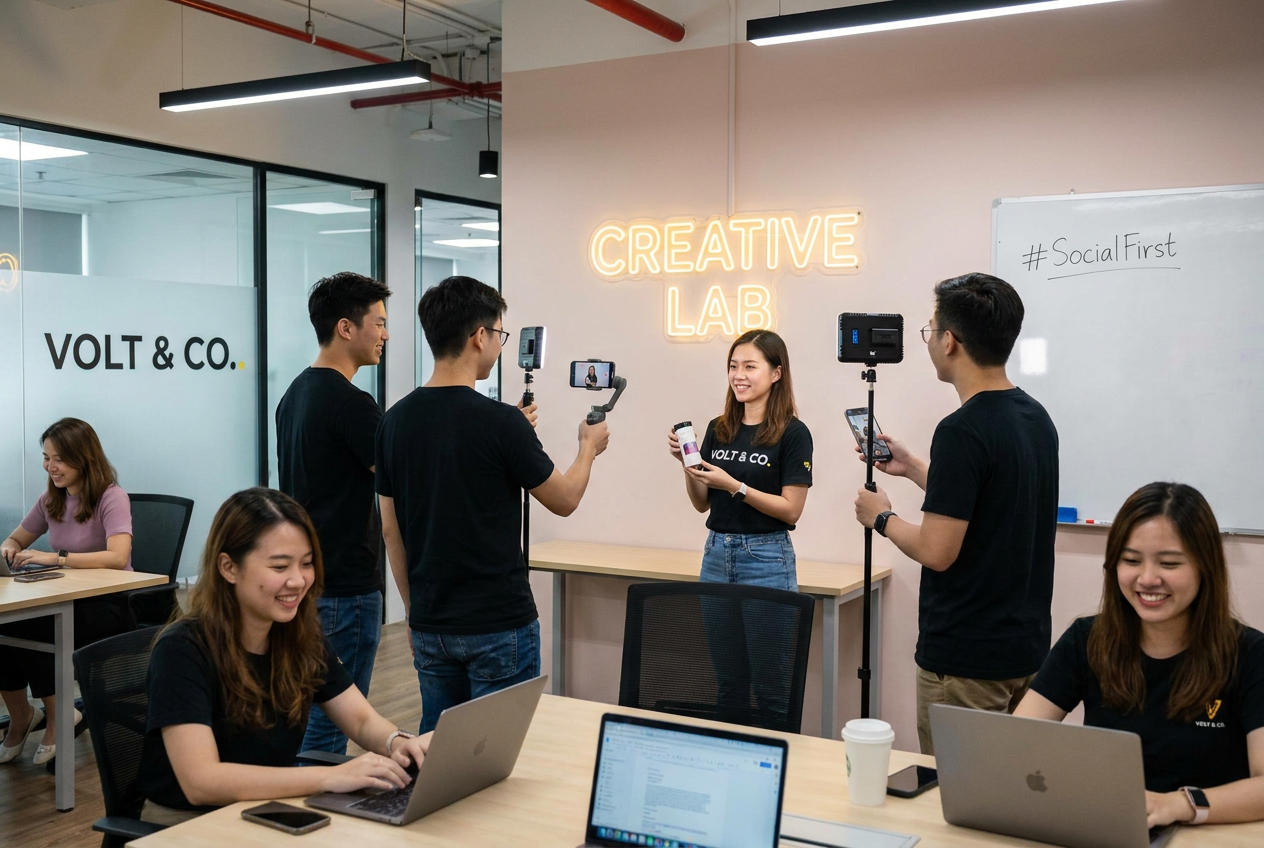
Marketing teams that activate employees as content contributors (not just brand ambassadors, but actual on-camera voices) are seeing measurable lifts in authenticity and reach. This doesn't have to be a massive undertaking. Even a handful of team members who are comfortable on camera can meaningfully extend your organic reach while making your brand feel like it's run by actual people.
5. Invest in Community Management as a Video Strategy
Posting great video is only half the equation. How you respond after posting matters too — and no, "Thanks for watching! 🙏" doesn't count.
Community management is getting renewed attention in 2026 because platforms are rewarding accounts that create genuine back-and-forth with their audience. A smart comment reply, a stitched response video, or a pinned comment that sparks real discussion can meaningfully extend the life of a video. For larger brands, this often means staffing your community management role with someone who understands your brand voice well enough to respond quickly and authentically — not someone just monitoring for complaints and @mentions from bots.
Metrics to Actually Care About
Not all video metrics are created equal, and whoever keeps celebrating 100k views on a video that drove zero action is due for a gentle reckoning. For organic social, these are the ones worth tracking:
Watch time and completion rate — tells you if your hooks and pacing are working (brutal but useful)
Shares and saves — the highest-signal engagement metrics; this is what algorithms reward most
Comments that aren't just emoji — a sign you're sparking real conversation, not just existential scrolling
Follower growth rate from organic video — a longer-term signal of whether your video content is actually building an audience
Vanity metrics like raw views can be genuinely misleading, especially for larger accounts. A video with 10,000 views and 500 saves is doing more for your brand than one with 100,000 views and 20 saves. One is building something; the other is just traffic.
The Big Picture: Depth Wins
If there's one theme running through everything working in organic social video right now, it's this: depth beats breadth. Fewer formats done really well. Real engagement over impressive-sounding numbers. Consistency over sprinting after every new trend like it owes you money.
For marketing teams juggling multiple stakeholders, long approval chains, and a content calendar that somehow always feels behind — that's actually encouraging news. You don't need to be everywhere doing everything. You need a smart content architecture, a production workflow that lets you move quickly, and a genuine commitment to creating videos your audience actually wants to watch.
That's exactly what Take2Content helps brands do. Whether you need help building out your organic video strategy, streamlining your content production, or just figuring out what's actually working on each platform (versus what just looks like it's working) — we're here for it.
Ready to stop guessing and start growing? Get in touch with the Take2Content team.